The Printer’s Ink That Never Dried: Jim Edgar and the First 40 Years of Al Shamal
Written By Trevor Eliott (Mr Fancy Fez) - Assistant Rabban - Al Shamal Shriners

Walk into an old print shop and you’ll never forget the smell. Ink sharp on the nose. Paper stacked in towers. The low rumble of presses that sound almost alive. That was Pioneer Press — a local institution that carried a big load for Masonry and the Shrine in northern Alberta.
In the corner of that shop, you could often find Illustrious Sir 𝗝𝗶𝗺 𝗘𝗱𝗴𝗮𝗿 (𝟭𝟵𝟴𝟵). For nearly seventy-five years, Jim worked in that shop. He emigrated from Glasgow, Scotland at fifteen, a wiry teenager with more determination than dollars, and found himself surrounded by men who believed in work, honor, and fraternity. Printing was his trade, but brotherhood was his life’s work.
Jim likes to tell the story of the two-day magic show that out-earned a ten-day circus. “We pulled in more on those two nights than we did the whole run of the big tent,” he laughs, shaking his head as if the math still doesn’t make sense. He’ll remind you of the programs, the flyers, the Sahida newsletters, the directories — “everything you held in your hand, we probably printed it.”
If you ask him about the Shrine, he’ll tell you straight: “It costs something to be a Shriner. But that cost is part of the joy.”
That’s Jim Edgar — ninety-two years old, still sharp as a blade, carrying the living memory of a temple, a fraternity, and a lifetime of friendship and philanthropy. And if you’re wise enough to sit with him, you don’t just get stories. You get lessons for leadership, lessons that fit squarely into the pillars of Energy, Mentorship, Visibility, and Purpose.
🏭 Sidebar: Pioneer Press – The Heartbeat in Ink

Pioneer Press has been part of Edmonton’s story since September 1894, founded by R.J. Pettapiece and soon after purchased by the McDonald family. In March 1963, a young printer named Jim Edgar and his business partner, the late George McEwen, took the helm and continued its legacy of craftsmanship and community service.
For more than a century, Pioneer Press has stood for integrity, quality, and teamwork — values that mirror those of the Shrine itself. Several employees have celebrated thirty-year careers under its roof, and the presses that once turned out Shrine programs, directories, and the Sahida are the same that printed banners, stationery, and community newspapers across Alberta.
Now a family-owned business well into its 130th year, Pioneer Press remains committed to the same principles that defined its founders: quality work, fair service, and pride in every page. For the Shrine, it was more than a printer — it was the voice of visibility, the quiet engine that kept our story rolling off the presses decade after decade.

Mentorship: The Living Link
Jim often frames things simply: “The more we change, the more it stays the same.”
It’s not a complaint. It’s a warning. Every generation of Nobles has faced the same problems — money, leadership, recruiting, apathy. And every generation has also had men who rose up to solve them.
Jim became that bridge. He learned under the early Potentates — men like John L. Pedden, Al Shamal’s first, who believed a Shrine temple in Edmonton could take root if men had courage. He worked shoulder-to-shoulder with Bruce McCullough, a Potentate whose frugality and steady leadership kept the temple solvent in lean years. And Jim, in turn, mentored younger Nobles simply by showing up, telling stories, and reminding them that memory matters.

Mentorship, for him, was rarely formal. It wasn’t a program or a committee. It was conversation. It was someone like Denise — thirty years at the office desk, holding the strings no one else thought about — quietly training her replacements by living example. It was Bruce saving the temple thousands by donating the printing of the Sahida — and in doing so, teaching that generosity is often more valuable than clever strategy.
That is mentorship at its best. Not flashy. Not loud. Just lived.
👤 Sidebar: Illustrious Sir 𝗝𝗶𝗺 𝗘𝗱𝗴𝗮𝗿 (𝟭𝟵𝟴𝟵)
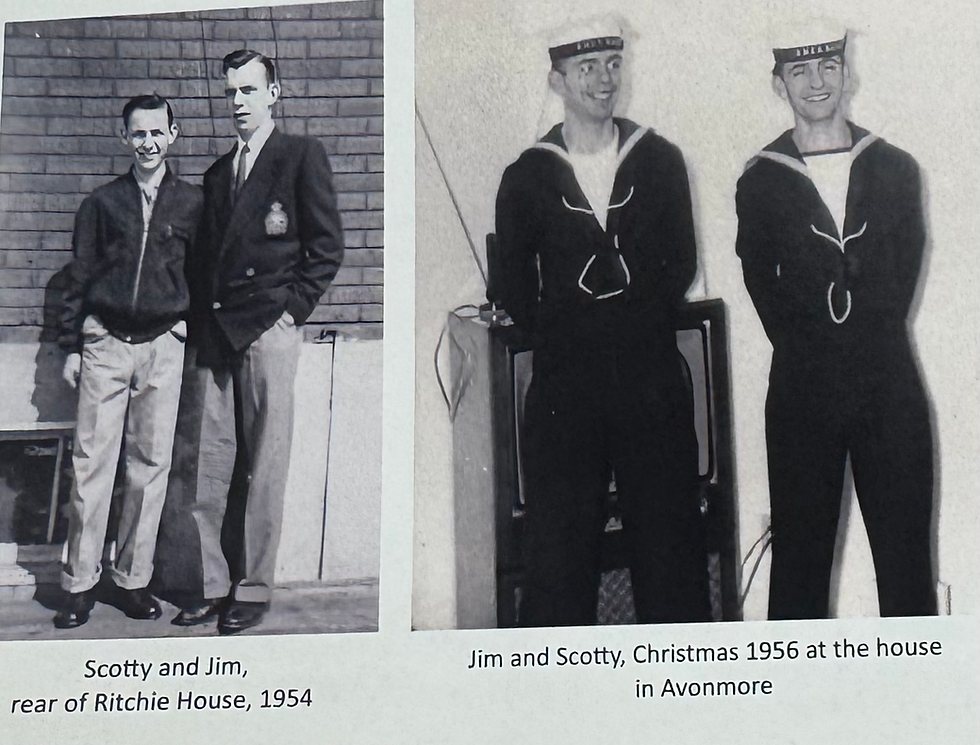
Born on March 22, 1934, in Paisley, Scotland, Jim Edgar emigrated to Canada with his parents in September 1949 and became a proud Canadian citizen in 1965. He married his lifelong partner, Lady Jessie Cox, on May 4, 1957, and together they raised three daughters — Patricia, Christine, and Jennifer — building both a family and a legacy rooted in community and faith.

Jim’s education began in Paisley and Glasgow and continued at Victoria Composite High School in Edmonton. He pursued business administration at the University of Alberta and completed executive programs through the Canadian Graphic Arts Association and the Printing Industries of America’s Airlie Foundation in Washington, D.C.
A lifelong printer, Jim rose from apprentice to owner. In 1963, he and George McEwen purchased Pioneer Press, where he served as Secretary/Treasurer and General Manager for decades. He also led Norser Business Forms Ltd., Maura Holdings Ltd., and partnered in PPL Computer Graphics.
Beyond the pressroom, he served as Past President of the Edmonton and District Minor Soccer Association, Past Vice-President of the Greenfield Community League, and supported the Edmonton Girls Pipe Band Association.
Initiated into Temple Lodge No. 167 in 1959, he joined the Alberta Consistory Scottish Rite ten years later and became a Noble of Al Azhar Temple and the Edmonton Shrine Club in 1970. He served as Worshipful Master of Temple Lodge (1973), Chief of the Pipes and Drums of Al Azhar (1977), and held nearly every office in the Edmonton Shrine Club — Vice-President (1981–82), President (1983), and Director (1979–80).

He chaired campaigns for the Shrine Circus and Magic Show (1971–85), helped found the Edmonton Shrine Club Building Association, and contributed to the Steering Committee for the New North Temple, culminating in his service as Potentate of Al Shamal in 1989.
His record reads like a lifetime of quiet, steady leadership — a craftsman’s precision applied to people, not just paper.
Visibility: Printing the Shrine into Existence

Pioneer Press wasn’t just a business; it was the engine of Shrine visibility.
Think about it. How did people know the circus was coming? Flyers. Posters. Handbills. How did families learn about Shrine fundraisers? Programs on kitchen tables. How did Nobles keep track of meetings and minutes before email and social media? The Sahida, printed faithfully, month after month.
Visibility wasn’t abstract — it was paper in your hands.
Jim tells of long nights in the shop, presses running, stacks of Shrine directories piling up, and deadlines looming. “If it was Shrine, we did it,” he says, proud but also pragmatic. It was work, but it was also witness. People saw the Shrine in their mailboxes, on their walls, in their kids’ hands at parades.
Today, our tools are different. Facebook posts. Instagram reels. Car show flyers that go viral before they ever hit a telephone pole. But the principle hasn’t changed: if people can’t see us, they can’t join us. If they don’t hear our story, they won’t know why we matter.
Visibility is not a luxury. It’s survival.
📍 Sidebar: How to Say “Al Shamal”
The proper pronunciation is Al Sha-maul — rhymes with shopping mall. Back in the early days, if a Potentate heard a Noble pronounce it like Al Sha-mall (as in pal), it could cost you a fine — always donated in good humor to Shriners Children’s. It became a playful reminder that while our work is serious, our fellowship should never lose its laughter.
Purpose: The Cost of the Fez

Jim doesn’t mince words. “It costs something to be a Shriner.”
He doesn’t just mean dues. He means the sacrifice of time, energy, money, even family convenience — the hours setting up chairs in the auditorium, the weekends running circuses, the nights spent printing rather than resting.
For Jim, that cost wasn’t a burden. It was a badge. He saw it in men like Biff, the veteran who rebuilt a lounge with his own hands and left behind a legacy strong enough to earn his name on the door. He saw it in Nobles who paid their own way to Imperial Sessions, not because it was easy but because it was the right thing to do.
Purpose is what made the cost worth paying.
And it’s what will make today’s Nobles willing to sacrifice again. When a new Noble asks, “Why should I give up my weekend for this?” our answer cannot be, “Because we need help.” It has to be, “Because what we do changes lives. And that’s worth everything.”
Purpose reframes cost into calling.
🍻 Sidebar: Biff’s Lounge — A Tribute in Timber and Sweat

Step inside Al Shamal’s lounge and you’ll see a sign that simply reads Biff’s Lounge. It’s named for a Noble who didn’t wait for committees or credit — he just went to work. “Biff” rolled up his sleeves, rebuilt the space by hand, and left it better than he found it. When the job was done, his Brothers decided to keep his name on the door as a reminder that dedication builds temples long after the bricks are laid.
The Dangers of Forgetting

Jim remembers when the temple had professional fundraisers who pulled in big numbers — magic shows, circuses, dinners that filled the coffers. Then came policy changes. “We weren’t allowed to do it that way anymore,” he shrugs. “Income dropped. We had to adjust.”
The same happened with leadership. One Potentate spent freely. Another cut spending to the bone. One group loved the circus. Another moved away from it. Each cycle looked new, but the pattern was always the same.
“The more we change, the more it stays the same.”
This isn’t cynicism. It’s reality. If we don’t learn from past patterns, we repeat them. But if we study them — if we preserve stories, scan old Sahidas, interview Nobles like Jim and Denise — then we inherit more than problems. We inherit solutions.
Energy: The Spark that Carries On

Though Jim doesn’t talk about it directly, his very life embodies the first pillar: Energy.
Imagine showing up at Pioneer Press day after day, decade after decade. Think of the energy it took to keep presses rolling, to keep Sahidas folding, to keep election ballots and Shrine directories landing in mailboxes. That energy wasn’t flashy. It wasn’t social media likes or circus spotlights. It was steady, consistent, faithful energy.
That’s the kind our temples need now — not just bursts of hype, but endurance. The kind that keeps newsletters coming out, keeps fundraisers on the calendar, keeps Nobles shaking hands at parades year after year.
Energy is contagious. And when one Brother carries it, others catch it.
Application in Shrine Life Today
So what do we do with Jim Edgar’s story?
Preserve your history. Scan old programs, magazines (like the Sahida), directories. Record oral histories. Ask older Nobles to tell stories at unit meetings. These aren’t relics — they’re roadmaps.
Guard your finances. Remember Bruce McCullough donating free printing? Every temple has men with gifts that can save money if asked. Steward Noble dollars like they matter — because they do.
Get visible. In Jim’s day it was flyers and presses. Today it’s social media, car shows, podcasts. The tools change; the principle doesn’t. If people can’t see us, they can’t support us.
Embrace the cost. Don’t shy away from telling new Nobles that being a Shriner requires sacrifice. Show them that sacrifice is part of the joy.
Mentor quietly. Not every mentorship looks like a program. Sometimes it’s sitting with a Brother and telling a story. Sometimes it’s letting a younger Noble watch you lead by example.
Mentorship & Legacy: The Chain Unbroken
Jim knows he won’t be around forever. That’s why he’s so quick to offer old materials — “You can borrow them, just bring them back.” He wants the history safe. He wants the legacy alive.

Every Noble has that same responsibility. Whether you’ve been in the Shrine five months or fifty years, someone is watching you. Someone is learning from you. Someone will remember you as the Brother who either carried the chain forward… or let it slip.
Legacy isn’t something we stumble into. It’s something we choose, one decision at a time.
The Footprints We Leave

When Illustrious Sir 𝗝𝗶𝗺 𝗘𝗱𝗴𝗮𝗿 (𝟭𝟵𝟴𝟵) completed his term as Potentate, he left behind more than a year of accomplishments — he left us words that captured the very soul of what it means to be a Shriner:
“Be nice. Have some fun. Leave some footprints.”
In his farewell message, Jim wrote that if he had convinced one committee to make a plan, encouraged one Mason to become a Shriner, or even driven the Recorder a little crazy in pursuit of progress — then he had left a footprint.
He said that if any Shrine Club laughed at one of his stories, if any traveler smiled because of his humor, or if any Noble felt a little more connected to the Craft because of something he said, then he had left a footprint.
And in his own good-natured way, he proved it. After stepping down from office, the photo wall of Past Potentates displayed a twelve-inch footprint in the space where his portrait should have been. “That’s when I knew,” he wrote, “that I’d gotten through to my Brothers — and that I’d left a footprint along the way.”
That’s pure Jim — equal parts humility, humor, and heart.
It’s also a reminder to all of us who follow: leadership isn’t about how loudly we speak or how long we serve. It’s about the quiet, steady impressions we leave on the hearts of those around us.
So as we carry the story of Al Shamal forward, may we follow Jim’s advice — not just with our words, but with our actions.
Be kind to each other. Enjoy the journey. And wherever you go in Shrine or in life — leave some footprints worth following.
Closing Takeaway

I will always cherish the afternoon I spend with Illustrious Sir Jim. At the end of our visit, Jim leaned back and smiled. His eyes twinkled with that mix of pride and pragmatism only age can give.
“The more we change,” he said, “the more it stays the same.”
He wasn’t being negative. He was handing over the baton. Because while the challenges of leadership, money, and membership will always circle back, so too will the solutions: Energy that endures. Mentorship that matters. Visibility that tells our story. Purpose that makes the cost worth paying.
Jim’s story is ink on our hands and fire in our hearts.
Now it’s our turn to carry it forward. Don’t just inherit a fez. Inherit the responsibility to leave footprints worth following.
A Note from the Author
This article is part of a broader project to document the first 40 years of Al Shamal Shriners.
I’ll be working on it in between other projects, with the goal of sharing something meaningful with all Nobles by the end of 2027.
Along the way, I’ll continue releasing stories like this — glimpses of the people, places, and traditions that shaped our Temple. I look forward to connecting with Past Potentates, Nobles, Ladies, and friends of Al Shamal.
If you have photos, documents, or memories that capture our history, please reach out to me at trevor@mrfancyfez.ca.
Let’s celebrate our past and keep building for the future. The heartbeat of Al Shamal is alive! ❤️🎩
Fraternally,
Trevor Eliott


Comments