Fezzes Across Borders: A Canadian Visit to Medinah Shriners
Updated: Aug 15, 2025
Wrtitten By Trevor Eliott - Mr Fancy Fez
Opening Scene – A Brotherhood Welcome
Fezzes Across Borders: A Canadian Visit to Medinah Shriners

“Welcome to Medinah,” said Assistant Rabban Dale Costello with a grin. “You’re my counterpart.”
There’s an unspoken truth in Shrinedom: the fez is a key. With it, you can walk into a building hundreds or thousands of miles away, and you’re not a stranger — you’re a brother. That feeling was immediate. Within minutes, Lady Amber and Dale were walking us down the hallway, introducing us to Nobles, trading stories, and laughing like old friends.
First Impressions – A Temple with a Story

The Medinah Shrine Center in Addison, Illinois is impressive not just for its size but for the energy that lives within it. Wide corridors open into bright meeting rooms, each bearing the stamp of the unit or club that calls it home. Along the walls, framed photographs, trophies, and display cases form a timeline that stretches back more than a century.

“This isn’t our first home,” Dale said as we paused by a large framed photo of an ornate downtown building. “We used to have a massive temple right in the heart of Chicago. That building’s now a Bally’s Casino. Maintenance costs were through the roof, so we moved here. This space works for us.”
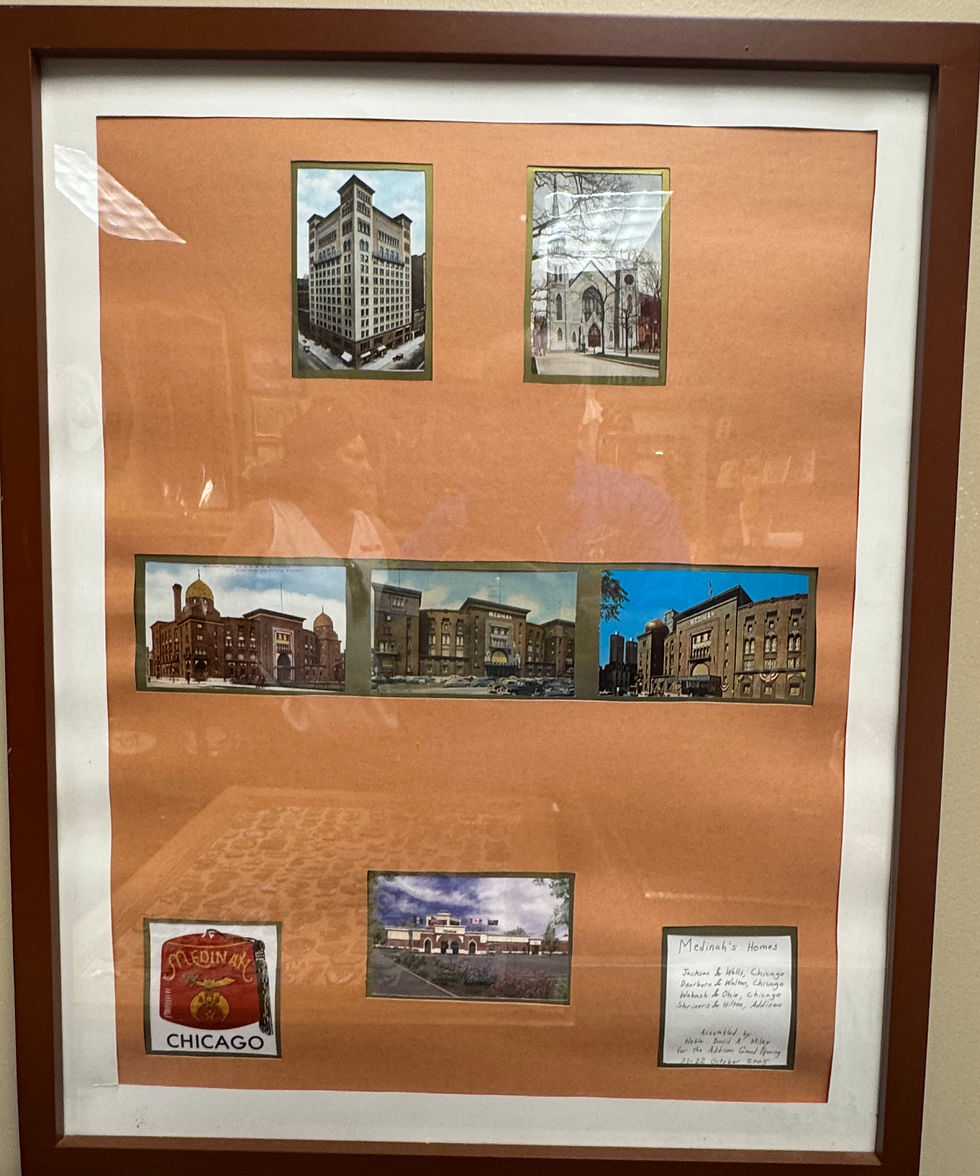
Founded in 1882, Medinah once had over 23,000 members. Today, they’re just over 2,000 strong. By modern standards, that’s still a large and active temple — but the number carries the same lesson every temple knows: membership is precious, and it needs constant care.
History in Every Hallway

“This is where the past lives,” said Dale as he opened the door to Medinah’s museum. Bill, the museum’s caretaker, has done an incredible job preserving Medinah's history. “Families bring us this memorabilia when their loved ones pass. We keep their stories alive.”
Stepping inside felt like opening a time-worn storybook where every page was alive. Glass display cases brimmed with mugs, pins, patches, and artifacts — each a fragment of Medinah Shrine history. Fezzes, ceremonial regalia, and vintage parade treasures surrounded the room, while old photos, historic signs, and handcrafted keepsakes seemed to hum with the voices of Nobles past. Every corner told a story — not just of a fraternity, but of a living legacy of fellowship, fun, and purpose.

A corner of the Medinah Shrine museum felt like stepping into a Potentate’s personal study — if that study were packed with a century of memories. Stacks of bound archives stood shoulder to shoulder with cabinets full of fezzes, camel figurines, ceremonial swords, and silver trophies. A “Welcome Shriners” banner from a long-ago celebration hung proudly, while vintage photographs and artwork offered a glimpse into winters, parades, and temples past. Every shelf, frame, and case whispered a reminder: leadership here is more than a title — it’s a legacy.
Some items, like ceremonial “Indian” unit costumes, are no longer worn for cultural reasons. Others, like ornate potentate jewels from the 1920s, remain timeless symbols of leadership. Each display whispered its own story, and together they told the tale of a temple that has been both witness and participant in the evolving life of the Shrine.
Medinah Shriners – A Storied Past

Founded in 1882 in the Chicago office of Noble Dr. Vincent Lumbard Hurlbut — one of Illinois’ most distinguished Masons — Medinah Shriners began its journey in borrowed rooms and grand halls across the city. Early meeting places included the armoury of Battery D and the Egyptian Room of Apollo Commandery, famed for its ornate mouldings and painted murals.

Their first ceremonial, on March 30, 1883, featured costumes and props… but no Potentate. Illustrious Sir Edgar P. Tobey was away conducting a court-martial, leaving the Chief Rabban to preside. At Corinthian Hall, the “burning sands” were recreated with alley junk — cans, bottles, and whatever else was at hand — proving that Shrine spirit doesn’t depend on fancy props.
Over the years, Medinah’s homes have included the Medinah Building on West Jackson Boulevard, a remodeled limestone church at 935 Dearborn Avenue, and finally, in 2005, the purpose-built Shrine Centre in Addison, Illinois. That move was celebrated with parades, fireworks, and the unveiling of the Silent Messenger Statue, which still greets visitors today.
Walking its halls in 2025, I felt that history in every detail — not as dusty relics, but as a living foundation for the fellowship and fun that Medinah continues to inspire.

A Meeting of Minds – Shared Challenges and Common Ground
As we walked, the conversation naturally shifted to the realities of running a temple in 2025.
“Al Shamal’s got around 320 members,” I said. “We’re much smaller than Medinah, but I think we’re all rowing the same boat.”
Amber nodded. “Membership’s the biggest thing. We’re seeing family become a bigger draw again. People want to be somewhere their spouse and kids feel welcome.”
That’s when the discussion turned to something I’d heard about from a Tripoli Shriner earlier in the day — their NexGen unit. It’s not a Medinah program, but the idea stuck with me.

Tripoli’s most recently chartered unit, NexGen, was formed in 2008 by a few of the Temple’s youngest members at a time when membership rolls were shrinking and event participation was low. The concept was simple but powerful: focus on bringing socialization and fun back into the Shrine, especially for young and newly-created Nobles.
The group — mostly under 46, though they’ve welcomed “more mature” members with a vote — has become a driving force in planning new activities, creating family-friendly events, and recruiting through networking and public engagement. Their motto says it all: “Leave egos and attitudes at the door.”
Hearing how it thrived in Milwaukee had my mind racing. At Al Shamal, we’ve got the people, the creativity, and the will — now we just need the spaces and the culture to make that kind of energy take root and grow.
Units and Clubs – A Shrine Within a Shrine

We moved through a series of unit rooms, each a world of its own:
Motor Corps – The night’s hosts, with precision riding skills and an unmistakable sense of showmanship.
Clown Unit – Bright walls, makeup mirrors, and racks of costumes ready for parades.
Aviators – Memorabilia from the days when members personally flew kids to Shriners Hospitals.
Genies – Parade “magic carpets” that draw smiles from kids along every route.
Police & Fire Units – Providing security at events, parading in uniform, and keeping the Shrine’s public presence sharp and professional.
Amateur Radio Unit – Complete with radios donated by Icom and a tall exterior antenna, connecting with Shriners across North America.
Then there were the “Hillbillies” working to revive their lighthearted ceremonial traditions, the Flintstones-inspired “Water Buffaloes” with their stone-age car, and the “Crabs” social club, which meets twice a year just for the joy of it.
Every doorway opened to a story, a tradition, or a laugh.
Keeping the Fun Alive
At one point, I shared something that’s been on my mind back home at Al Shamal.“We let too much of the fun slip away,” I said. “If it’s not fun, people stop showing up.”
For me, bringing that spark back isn’t optional — it’s a challenge I’m taking head-on. The Shrine was built on fellowship, laughter, and a little bit of good-natured mischief, and I’m determined to see that spirit rekindled at Al Shamal.
Here at Medinah, fun wasn’t just preserved — it was woven into the fabric of everything they did. Even their Segways for parade use came with a running joke: “We’ve got two that work, one for parts, and one just for moral support.” That kind of humor doesn’t just make people smile — it keeps them coming back.
Fundraising with Flair
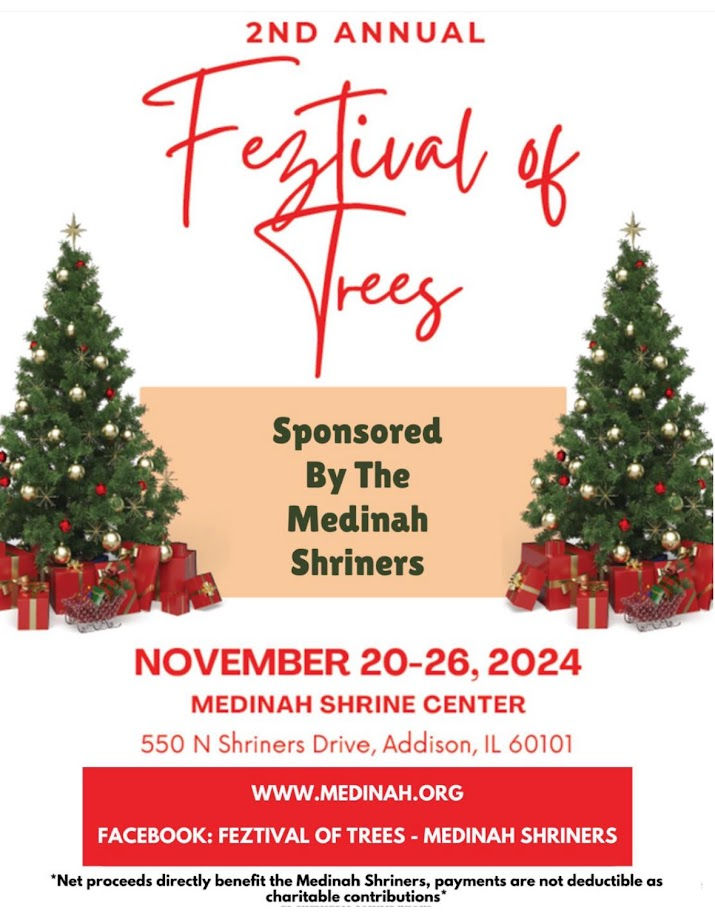
When I asked about major fundraisers, Amber’s face lit up.
“Our Feztival of Trees is huge,” she said. “Over Thanksgiving week, we fill the ballroom with decorated trees. Units, clubs, and businesses each sponsor one. We don’t charge admission — just sell raffle tickets for a dollar. You can win the whole tree.”
Last year, they had about 50 trees, each a work of art. The event draws in families, sparks media coverage, and plants Medinah firmly in the heart of the community’s holiday traditions.
Other fundraisers include sportsman’s raffles, which thrive in rural Illinois, and experiments with big-cash raffles — though those face stiff competition in the Chicago charity market.
The Blue Lodge Connection
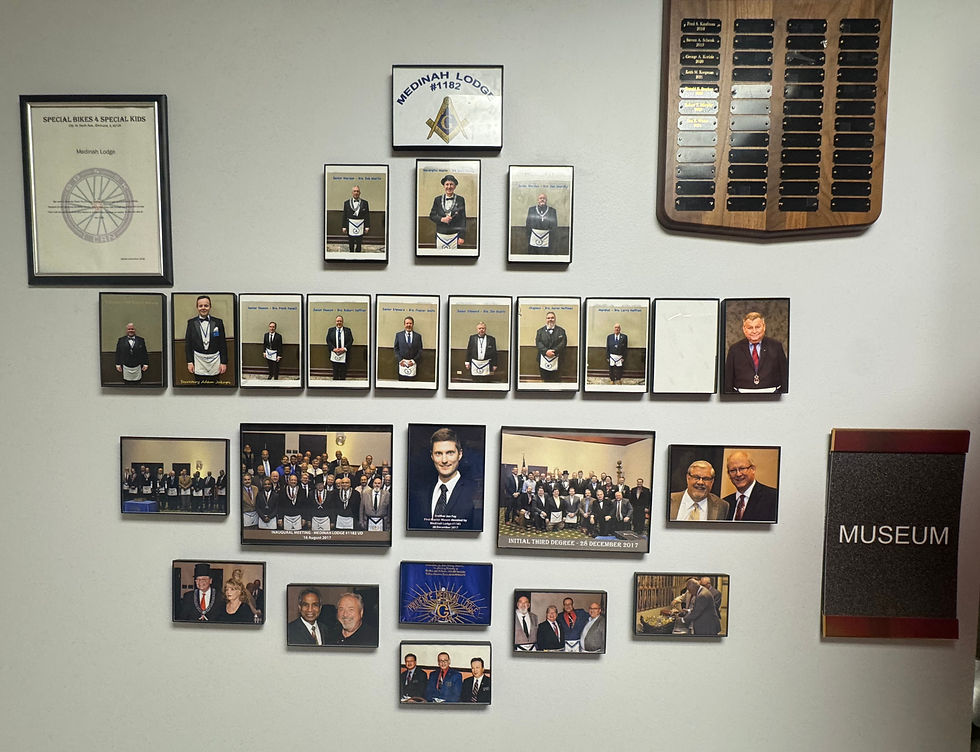
The relationship between the Shrine and Blue (Craft) Lodge is strong here, though not without challenges.
“Some guys join the Shrine and vanish from Lodge,” a Noble admitted. “They still pay dues, but they’re not active. That’s a loss for everybody.”
Medinah’s answer? A Blue Lodge that meets right in the Shrine Center. It keeps the path from Mason to Shriner visible, natural, and full of opportunity.
Celebrating Brotherhood on the Open Road: The Motor Corps 70th Anniversary & The Widows Sons

In 2025, the Medinah Motor Corps marked an extraordinary milestone — 70 years of service, showmanship, and speed. Founded in 1955, the Motor Corps has been a fixture in parades, community events, and Shrine gatherings, thrilling crowds with precision drills, roaring engines, and unmistakable esprit de corps. Over seven decades, their ranks have included skilled riders, mechanical masters, and Nobles who understood that every ride was an opportunity to raise the profile of the Shrine and its mission.
The anniversary was not just a nod to the past, but a celebration of what keeps the Motor Corps vital today: the bond between Nobles, the joy of performing together, and the unwavering commitment to fun with a purpose. Through changing times and evolving machinery, their polished chrome and polished brotherhood have remained constants.
Sharing that spirit of the road is another group bound by fellowship and throttle — The Widows Sons Masonic Riders Association. While distinct from the Shrine, the Widows Sons are a Masonic-affiliated motorcycle association dedicated to raising Masonic awareness in the motorcycle community, supporting widows and orphans, and enjoying the open road together.

The two groups often cross paths, united by shared values: freedom, fraternity, and philanthropy. Whether leading a parade, riding for charity, or gathering at a roadside diner, the Motor Corps and Widows Sons prove that a motorcycle can be more than a machine — it’s a bridge between brothers, a moving emblem of Masonic fellowship, and, in true Shrine style, a vehicle for joy.

Closing the Day – Brotherhood in Action
As the Motor Corps 70th Anniversary celebration wound down, the voices softened, the laughter grew warmer, and the room carried that contented hum of an evening well spent.
I reached into my case and pulled out the Al Shamal fez — one worn by a Past Potentate. Illustrious Sir Rupert C. Solis stepped forward, his eyes widening slightly. I placed it in his hands, and his fingers lingered on the brim for a moment, like a craftsman feeling the weight of a tool before putting it to work.

Without a word, he reached into his own case and drew out a Medinah fez from the 1960s — its felt rich with history, its tassel carrying the faint scent of time. He placed it in my hands, and for a moment, neither of us spoke.
“Now that’s Shrine history right there,” a Medinah Noble murmured from the side.
It wasn’t just an exchange; it was a bridge. A piece of Edmonton now lived in Illinois, and a piece of Illinois would return with me to Edmonton — a tangible link between our temples, one that would outlast handshakes and photographs.
Through the doors, the warm Chicago night waited. Julia and I stepped outside, the hum of the city blending with the echoes of the evening. She looked at me and said, “That felt like visiting family.”
She was right. This wasn’t just a visit — it was proof that the fez erases miles and differences.

Reflections – Medinah Through the Lens of EMVP

Energy – The moment we walked through Medinah’s doors, the energy was palpable. It wasn’t an abstract “spirit” — it was action, laughter, movement. Units weren’t just names on a roster; they were living, breathing groups doing things. Energy here is kinetic, and it’s contagious.
Mentorship – From Dale’s warm welcome to Amber’s detailed explanations, to Rupert sharing not just a fez but the story behind it, mentorship wasn’t formalized here — it was woven into every interaction. Nobles didn’t just show me what they do, they showed me why they do it, and why it matters. That’s the difference between orientation and inspiration.
Visibility – Medinah knows how to be seen. Their Festival of Trees isn’t just a fundraiser; it’s a community anchor. Their Motor Corps doesn’t just ride in parades; they perform. Their Blue Lodge connection is visible in both directions — a constant reminder to the community and to Masons that the Shrine is here and active.
Purpose – Everything tied back to their mission. Whether raising money, building fellowship, or trading fezzes, the underlying purpose was clear: strengthen the brotherhood so that they can strengthen the philanthropy. Fun was not separate from purpose — it was the fuel that made purpose sustainable.
Medinah reminded me that EMVP isn’t a theory you tack onto your operations. It’s a living cycle — energy fuels mentorship, mentorship builds visibility, visibility draws people to your purpose, and purpose reignites your energy. Miss one, and the system sputters. Keep them all alive, and your temple thrives.
Reviving The Heartbeat

It was no coincidence that the fez we presented to Medinah came from Illustrious Sir Larry Heron — Past Potentate of Al Shamal and a cornerstone of the Motor Corps. Larry’s life was fueled by humor, service, and the belief that “Attitude is Everything.” In passing his fez, we didn’t just hand over regalia — we passed forward the pride of the road, the brotherhood of the parade, and the enduring spirit of a Shriner who led with heart and lived with purpose.

This fraternal visit was more than a handshake across jurisdictions — it was part of reviving the heartbeat of our fraternity. Every shared laugh, every story told, and every tradition honored breathes energy back into the Craft. By connecting temples, honoring our past, and inspiring our present, we strengthen the pulse that keeps the Shrine alive for the next generation. Larry’s fez is now more than a keepsake — it’s a spark in that revival.
Questions for Reflection & Action

Energy – When someone walks into your temple or lodge, do they feel the life of the place?
Mentorship – How do you turn a handshake into a guiding relationship?
Visibility – What are you doing that’s not just seen, but remembered?
Purpose – Can every member explain why your organization exists in one sentence?
Where has “fun” been lost in your group, and how can you reclaim it as a core value?
How does your temple or lodge’s history inspire, rather than just decorate walls?
If your temple disappeared tomorrow, what would the local community lose?
What unit, club, or event could you revive that once brought energy to your members?
How can you make cross-border or inter-jurisdictional visits a regular part of your culture?
What symbolic exchanges — like the fez swap — could create lasting bonds beyond your own membership list?
Crossing the Border Home
Walking out into that warm Chicago night, I realized this trip wasn’t about numbers, titles, or even buildings. It was about proof — proof that when Energy, Mentorship, Visibility, and Purpose are alive and working together, a temple becomes more than a place. It becomes a force.
And forces, unlike buildings, can cross any border.


Comments